Trying the Mische Technique in Acrylic


At the beginning of this summer I had the honor of being asked to exhibit my work, in a years time, at a gallery in the town I grew up in. I was quite pleased to have the opportunity offered as I have been working on a new series of paintings, and to be honest, I can be rather slow about completing paintings without a deadline!
I have been painting in watercolor for years since I graduated with a BA in art, but over the past year, I decided to try my hand at acrylic to work on a series of more developed paintings. I had worked with oils a little bit in college and loved them, but didn't feel like I had the proper studio setup afterwards to use them safely as they can be quite toxic and even flammable! Acrylic in this case seemed like a safer alternative, and I muddled my way through a few paintings to a result I was pleased with. Although I was happy with the result, I couldn't help but feel like I was probably wasting a lot of time by not being very familiar with the techniques of building up a painting in layers. This time I decided to go into my next project with more of a plan!
My favorite way to get some fresh inspiration and guidance on new projects is a trip to my local library. The one closest to me is quite small but has a fantastic selection of art-related books that I love perusing. Since I have been working on painting historical subjects, I wanted to learn more about the painting techniques used by the artists I admired from the 15th - 17th centuries. Providentially, a book called Techniques in Painting: Learning from the Dutch Masters by Brigid Marlin caught my eye. It contained some helpful looking tutorials that were intended to be used with alternating layers of oil glazes and egg tempura, but I thought it would be worth trying to see if it was possible to get similar effects in acrylic!
The book teaches the Mische Technique or "mixed technique" which has it beginnings in the renaissance, and was employed by artists such as Albrecht Durer and Jan Van Eyke. It allows for highly detailed subject matter to be luminously rendered by alternating layers of white egg tempura on colored grounds and finishing off the image through overpainting with semi-transparent layers of oil color. The technique was later revived and documented in the early 20th century by the German artist Max Dorener and Austrian artist Ernts Fuchs who was a leading figure in the Vienna School of Fantastic Realism. Modern practitioners of this technique seem to hold a rather mythic view of the style, deeming it a somewhat spiritual practice, which is demonstrated in much of the subject matter they seem to gravitate towards. On a practical note, I can see how the technique is very helpful in creating scenes that you are cobbling together from different sources as it does allow you to spend a lot of time figuring out the lighting and and refining the image to create a sense of a cohesive whole. The time spent working on each layer does allow for reflection and contemplation, as you are continually building on what you already put down on the layer underneath. It is also thought provoking to consider the long history of artists who used the technique to craft their exquisite artworks!
First Impressions on the Mische Technique Acrylic
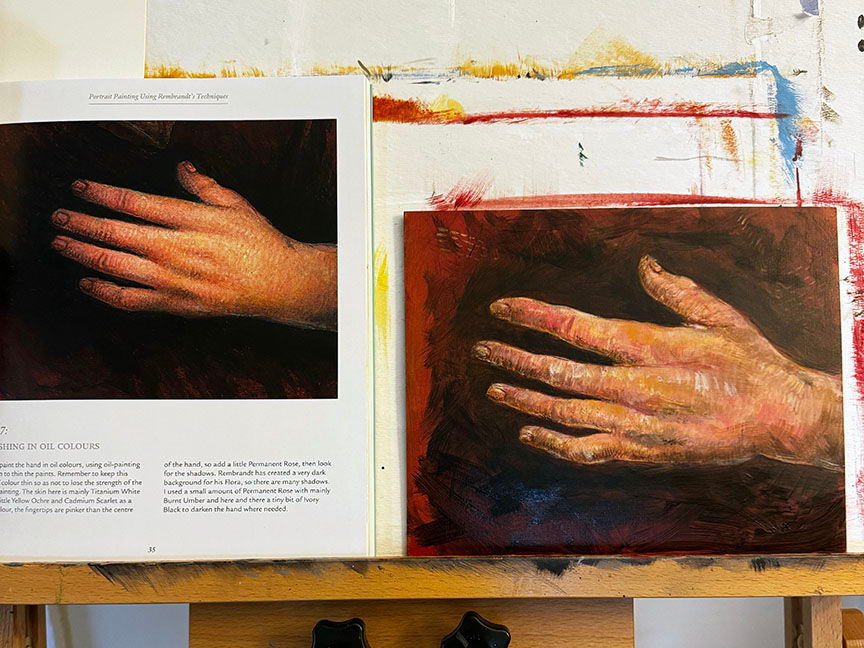
Upon returning to the studio, I read through the book and decided to test out a tutorial, which was a step-by-step guide for painting a hand based on one of Rembrandt's portraits. I got along pretty well for the first part, which involves using the smallest round brush possible to paint in thin white hatch-marks to describe where the light hits the subject on a red imprimatura (an initial, thin, transparent layer of color applied to a canvas or other painting surface). After this initial step, you're supposed to add on successive layers of color glazes (red, yellow, blue) and then, after a final round of white hatching, use thin semi-transparent color to bring the image to the final stage through soft and subtle color glazing.
Immediately I had some difficulties trying to find comparable colors in acrylic to some of the oil paints suggested in the book, but after some research was able to get a close approximation. The next challenge I had was realizing that glazing in acrylic is not as easy as it is with oil! Even using a glazing medium, the paint dried so quickly that blending the way I was accustomed to with oils was just not possible. I played with adding extender and blending mediums to my paint which helped somewhat but I realized I would need to learn to adapt and learn some more acrylic painting methods along the way.
Using the Technique for My Own Paintings
I decided that since the technique was so laboriously time consuming I should work on some small paintings before I went on to try it on a large scale, as I needed to complete about 10 new paintings by next spring for the gallery. For my references I chose two photographs I had taken of interesting objects at one of my favorite living history museums, Henricus Historical Park. I chose to work on both of them in stages, using similar colors to complete each image.
First, I drew out my image in waterproof ink onto my prepared masonite panels for my painting surface. Next, I mixed up a combination of cadmium red and burnt sienna paint with a bit of acrylic glazing medium which helped make the pigment more transparent. The glaze seemed very thin so I ended up doing about 3 coats of red on each, drying it with a hair-dryer on low in-between coats to speed up the drying time.


At this point in the process I felt quite enthusiastic! It seemed like the image was already looking three dimensional and everything was rendered (the process of adding detail, shadow, and lighting to an image) to a similar level of finish. Heck, I thought to myself, I feel like it's almost done already! Unfortunately for me, although I had successfully built a strong base with which to complete my painting there would be many long hours to go before they were finished.
The Second & Third Stages
The next stage was to put a glaze of yellow ochre over both images, which had the effect of turning my background layer orange and my white details yellow. I then had to go over all of the formerly white areas again and further refine the forms with more finely detailed white acrylic. At this point, the book suggested that I add in a dark umber color for the shadows in the painting to give it more tonal definition to give it "bones" so to speak. This would leave me with a highlight (white), mid-tone (orange), and shadow (raw umber). I chose to try out applying the raw umber to the basket piece but not the still life of the jug to see the difference. My thought was that I would add extra dark blue on the third layer for the jug since it had less mid-tones in the image than the baskets. The goal of each stage is to progressively build up and refine the light areas, so it wasn't necessary to cover every little bit of the yellowed lines from the first layer, but to try to use the new white layer to pull out the brightest area. The same process was repeated in stage 3 after adding 3 glazes of manganese blue.


The goal of each stage is to progressively build up and refine the light areas.


At this point in the process I felt very happy with how three dimensional everything was looking, but I felt like I had gone a bit too dark with the blue and wasn't sure how easy it would be to use thin glazes of color to cover it. I probably should have gone in with more white to pull those areas I was concerned about out more but I decided I would just cover it with slightly more opaque paint when adding in the colors. My impression at this stage was that now that I had everything in place, I would just add a few color glazes and (HEY-PRESTO!) It would be done.
The Final Stage of Coloring: Pros and Cons
As previously stated, I had a lot of trouble using the acrylic paints for glazing, and as a result it was quite difficult to execute the final steps of adding color. I found that I was able to apply transparent paints like transparent yellow oxide with relative ease without covering up my work underneath, but if I used more opaque paints then it would quickly dry and permanently cover what I had so laboriously put down underneath it without being able to wipe it away. It ended up being quite a lot of work at this stage, approximately an additional two weeks of studio time per painting. Another complication that arose was the blue underneath was quite difficult to cover in the basket painting. I wound up with a blue outline around a lot of the objects that was difficult to get rid of and didn't make sense visually. In the future I think I will either skip this layer or apply it very sparingly to the areas where it would look best.
On the other hand, the act of building up the images successively in layers made me very familiar with the forms I was trying to paint and repainting them in color was comparatively easier than if I had been trying to figure out everything in one layer. It helped me to pre-establish the values (relative light-dark areas) before worrying about how to paint in the color temperatures (relative warm-cool hues). I think this technique is extremely helpful for crafting a very refined image even if the final color layers are not as easy to apply as they would be with oil. I will probably try to incorporate elements of this technique going forward with acrylics, although I will probably not go through all three rounds of underpainting.
Closing Thoughts
I really loved getting to learn this method of painting and thought that Brigid Marlin did an excellent job of demonstrating it in her book. At some point in the future I would like to invest in painting with oil colors and larger scale paintings, but for the short amount of time I have to put a show together by next spring I don't think it would be practical to start now. If you're an oil painter, however, I would highly recommend trying it out! One of the areas I would like to improve on is really seeing the dark and light values of subjects and colors accurately, and I think this mode of working is beneficial for that. Another upside is that it is an extremely economically conservative way of using your pigments! By working mostly in layers of white, and using thin color glazes only at the end, I can see how much the old masters valued their precious and hard to obtain pigments.
One of my favorite takeaways from the book was a quote she summarized from Giorgio Vasari (1511-1574) in his book "Lives of the Most Excellent Painters, Sculptors, and Architects".
"He warned students of Titian that behind the apparent carelessness of his later painting there lay a vast store of experience. He therefore advised young artists not to attempt this "rough manner" until they were older. He stressed that artists should first learn by mastering a painstaking and fine technique, and only attempt this rough manner later in life." (p.28)
I feel that there is definitely merit to this advice that still applies to artists in our contemporary setting. Certainly, very few of us have the privilege to be classically trained by an old master in their studio, or the same amount of undistracted time dedicated to artmaking in this fast driven world, but I think that since it is such a challenge to master an artistic discipline, compared to feeding a prompt into a computer program to generate an image, that in a way it feels even more important to use art as a means of seeing the world and expressing our vision as human beings. We may never get to the level of skill in our craft that we would like to achieve, but I find that the process of building the mental discipline of keeping at it to be rewarding. So let's all keep at it together, doing the hard things and seeing what fruit is grown from our labor.
Mische Technique Acrylic
as an acrylic painter who has been fascinated by the mische tecknik for years, this was incredibly helpful and inspiring! thank you for sharing and for creating art!